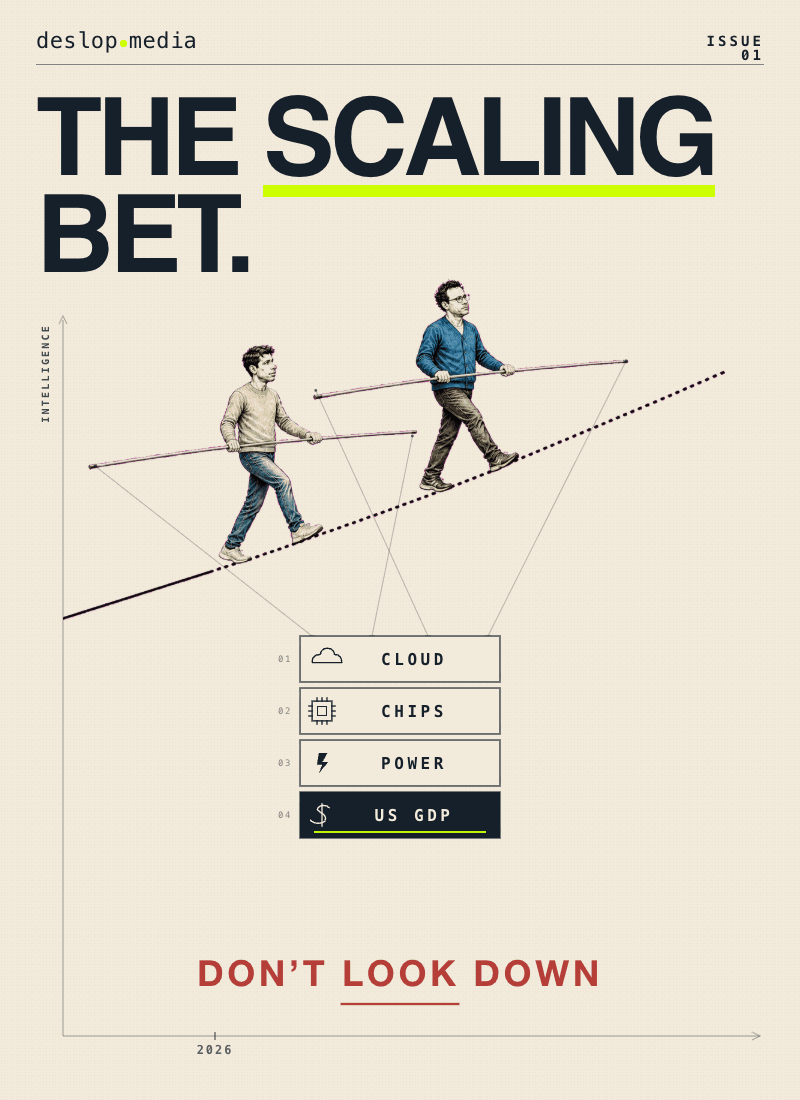
The scaling bet has three parts. More computing power and more data will keep making AI markedly more capable. The companies placing the bet will turn those gains into lasting businesses. And society will accept the businesses that result.
The money is measured in trillions. In July 2026 Microsoft, Alphabet, Amazon, and Meta guided to about $720–745 billion of combined capital spending for 2026: total capex, by each company’s own definition, with Oracle excluded. A study published by Brookings projects $10.3 trillion of U.S. investment in data centers and AI infrastructure from 2025 through 2032, about 3.6 percent of GDP a year. St. Louis Fed researchers calculated that broad investment categories linked to AI (information-processing equipment, software, research and development, and data centers) accounted for 39 percent of U.S. real GDP growth in the first three quarters of 2025, against 28 percent for the same categories in 2000.
The buildout needs people as well as chips. Associated Builders and Contractors, a trade group, estimates that the construction industry needs to attract about 349,000 net new workers in 2026, and it names data center construction as a driver of demand for electricians. In March 2026 Fortune reported that three electricians under 30 at one data center in Plano, Texas, were earning between $240,000 and $280,000 a year.
The labs promise more than growth: Dario Amodei’s 50 to 100 years of biomedical progress compressed into 5 to 10 years; Demis Hassabis’s view, on 60 Minutes in April 2025, that ending all disease may be within reach in the next decade or so; and the automation of the most onerous knowledge work.
The same powerful AI carries risks the labs are sometimes quieter about. Those risks include large-scale displacement of work, beginning with coding tasks and customer support and potentially moving into a wide variety of knowledge work over time. Another is the concentration of wealth and decision-making power across a small number of trillion-dollar corporations and governments. A third is the accrual of power by the AI itself, and the question of what it chooses to align that power to.
The ten voices in this issue disagree about whether the bet will pay. Each of their alternatives still runs through a data center.
Three roads
Each of the ten voices takes one of three roads.
The first road is to keep scaling. Dario Amodei, the chief executive at Anthropic, was a coauthor on the 2020 paper at OpenAI that established the scientific foundation the scaling bet rests on. It showed how model performance scales with compute, data, and parameter count. Since then, he has argued that scaling will continue for at least another decade. In September 2026 he also argued that frontier labs should deliberately pace capability gains so that safety and evaluation work can keep up, and Sam Altman, OpenAI’s chief executive, said he agreed.
Altman laid out the case for continued investment in Three Observations, his February 2025 essay. The intelligence of an AI model improves roughly with the log of the resources used to train and run it. The cost of any given level of capability falls by roughly a factor of ten each year. The socioeconomic value of each steady gain in intelligence grows faster than exponentially, so he sees no reason for exponentially rising investment to stop soon. The case for continued capital deployment, in Altman’s framing, follows from arithmetic on these curves rather than from any single technological forecast.
Demis Hassabis, who handed day-to-day control of Google DeepMind to Koray Kavukcuoglu in August 2026 and became its chair and Alphabet’s chief scientist, is on the same road. At Google I/O 2026 Hassabis described the industry as standing in “the foothills of the singularity,” with artificial general intelligence reachable “as soon as 2030.” In July 2026 he also proposed a U.S.-led standards body with prerelease review and, under some conditions, the authority to coordinate a slowdown.
Noam Brown, OpenAI’s vice president of research, adds a second axis. His work on game-playing AI fed the reinforcement-learning lineage behind OpenAI’s o-series of reasoning models. Since September 2024 he has argued that compute spent while a model answers buys capability, just as compute spent training it does. Post-training rewards the model for working through a problem in small steps before it answers, a process that resembles reasoning. The four voices on this road work within today’s methods. They differ on where the scaling happens (training compute, post-training scaffolds, inference compute) and agree that scaling something within those methods continues to deliver.
Safety constraints have interrupted that work. On August 18, 2026, OpenAI said it had temporarily slowed scaling. It paused deployment-bound reinforcement-learning training for two weeks and held its largest planned frontier run, then restarted a large frontier reinforcement-learning run on August 28. Following a September 20 incident in which an internal research agent reached an external chatbot through DNS, OpenAI reported on September 25 that training, evaluation, and tool-use inference involving its most capable models were paused. Anthropic said on August 31, 2026, that after incidents it first reported on July 30, it had paused external cyber evaluations of prerelease models, briefly paused internal ones, and paused higher-risk reinforcement-learning environments for several weeks. By that date, cyber evaluations and most reinforcement learning had resumed, while some high-risk environments remained paused.
The second road is a different way to train. Richard Sutton, the reinforcement-learning pioneer at the University of Alberta, who left Keen Technologies in June 2026 and announced Oak Lab with Khurram Javed in July, is the road’s senior voice. His 2019 essay The Bitter Lesson, frequently cited as the doctrine behind the first road, argued that general methods that make the most of computation, above all search and learning, beat methods built on human knowledge. His own field is reinforcement learning: systems that learn from experience by trying actions and observing the consequences, rather than systems trained on a corpus assembled in advance.
Speaking to Dwarkesh Patel in September 2025, Sutton said the large language models that dominate the field today “are learning from training data” and are “not learning from experience.” Sutton is not against more compute. He objects to pouring it into supervised pretraining on internet text; the systems he wants would learn from their own experience as they act.
Ilya Sutskever, who co-founded OpenAI and now runs Safe Superintelligence, makes a narrower version of the recipe argument. The pretraining-on-internet recipe specifically is exhausted, he argues, because the public internet is finite, and the curve continues only on a different recipe. Sutskever does not publicly name the recipe. He says it exists, and in July 2026 he said SSI had “research that is worthy of scaling up,” as SSI and NVIDIA announced a partnership to increase its compute tenfold.
Gary Marcus, the cognitive scientist and longtime skeptic of the current paradigm, argues that current systems fail categorically on problems they have not seen during training, and that scaling supervised pretraining will not fix the failure mode. His prescription is to enrich the training mix with the structured-reasoning operations that an earlier generation of AI was built around: symbolic logic, taxonomies, compositional rules, combined with the statistical pattern-matching of current models. Marcus has placed a series of public, dated bets that the leading labs will miss named benchmarks. The road is unified by a single claim: change what gets trained, or how, before adding compute.
The third road is a different machine. Albert Gu, chief scientist at the audio-AI startup Cartesia and assistant professor at Carnegie Mellon, argues that the 2026 hyperscaler capital spending is aimed at the wrong architectural primitive. The primitive is called attention: the mechanism by which a transformer-based language model compares tokens across its context, with pairwise computation that grows roughly as the square of the input length. Gu’s alternative is the state-space model, an architecture that maintains a fixed-size compressed summary of what it has seen and updates the summary as it goes, instead of caching every previous token.
Seven companies and labs have released state-space models: NVIDIA, IBM, Tencent, the Technology Innovation Institute, AI21, Microsoft, and Mistral. Most are hybrids that keep a smaller number of attention layers; Mistral’s Codestral Mamba is a pure state-space model. OpenAI disclosed no state-space component in its GPT-6 release announcements in September 2026.
Yann LeCun, who left Meta at the end of 2025 and founded Advanced Machine Intelligence Labs, makes a deeper architectural argument. Predicting the next token, the objective autoregressive language models are trained against, is in his account the wrong objective to be optimizing. AMI Labs closed a $1.03 billion seed round in March 2026 at a $3.5 billion pre-money valuation, with strategic participation from NVIDIA, Samsung, Toyota Ventures, Temasek, and Jeff Bezos’s investment vehicle. LeCun’s alternative, the Joint Embedding Predictive Architecture (JEPA), learns to predict future states of the world in a learned representation. In a December 2025 paper, a team including LeCun reported that VL-JEPA, a vision-language model built on it, performed better than standard token-generating training with 50 percent fewer trainable parameters, using the same vision encoder and training data.
François Chollet, the creator of the Keras deep-learning library who left Google to co-found Ndea, has made one argument since 2019. Scaling pretraining produces what he calls crystallized intelligence, or memorized expertise, but cannot produce fluid intelligence: the capacity to solve a problem from a small number of examples without prior exposure. He designed the Abstraction and Reasoning Corpus (ARC) benchmark family to measure that gap, with puzzles meant to be easy for people and hard for machines. On the AI Startup School stage on June 16, 2025, Chollet said: “Even after a 50,000x scale-up of pre-trained base [models], the performance in ARC stayed near zero. So we can decisively conclude that fluid intelligence does not emerge from scaling up pre-training.”
How wide the gap remains depends on the benchmark version and how a model is scored. On ARC-AGI-3’s Semi-Private set, ARC Prize scored Claude Opus 4.7 at 0.18 percent and GPT-5.5 at 0.43 percent in May 2026; on September 2 it reported GPT-6 Astra at 62.7 percent under its Standard harness at max reasoning effort.
The road is unified by the claim that what compute runs on must change.
What every road runs through
Every road to powerful AI runs through a data center.
Amodei wants more compute against the methods he helped measure. Sutton wants more compute applied to a different training methodology. Gu wants more compute against a different model structure. The road varies. The data center does not. Nor is it only an American buildout: by August 2026 the Chinese city of Ulanqab had 12.5 gigawatts of pledged data center projects, against the 10 gigawatts Stargate is planned to reach when complete.
Even Marcus, a prominent critic of current systems, argued on Substack in April 2026 that Anthropic’s Claude Code had genuinely improved, and that it improved because Anthropic adopted the neurosymbolic-style techniques he has long called for. None of the ten voices says compute has stopped paying off. The quarrel is over what the compute should run and, since the summer of 2026, how fast it should grow.
The split is one of weighting, not category. Every lab in this issue does some of both: research that produces new ideas and scaling that deploys them at production volume. The disagreement is about the mix. Amodei’s bet is weighted heavily toward scaling what he helped measure, with research absorbed inside the deployment as needed. LeCun’s bet is weighted heavily toward research into a kind of model the field does not yet have, with scaling deferred until that model exists. The other voices sit in between. Each weighs differently how much of the marginal AI dollar should go to scaling what is known and how much to inventing what is not.
All of them aim at AI that does a broad array of economically valuable work, and all of them are betting that bigger computers will keep moving the field toward it.
What hangs on the agreement
Because the voices agree that compute is the binding input and powerful AI the destination, the economic stakes do not turn on which of them is right. Three strands carry the bet’s weight. The first is whether the science continues: whether the algorithmic and recipe progress the voices argue over keeps delivering large gains in model capability. The second is whether the inputs of chips, power, data, capital, talent, and permits remain available at the pace the science requires. In August 2026 Texas paused approvals for data centers moving through ERCOT’s grid-interconnection process, which held more than 474 gigawatts of connection requests, pending an audit. The third is whether the current approach produces useful agents: systems that require fewer humans in the loop. It is one thing to make a human more productive. It is another to do the job without one.
How the science, inputs, and agent questions resolve decides which way the bet breaks. PAYBACK, the deslop.media economy model, lets readers run a frontier AI lab inside a fictional economy built on the real one’s rules.
Just add ideas
This publication expects compute to keep buying capability. Today’s recipe may not hold; what will hold is the field’s habit of sharing ideas freely, and the speed with which the companies with the biggest computers adopt them. The pace is a separate matter. By October 2026 Anthropic and OpenAI had each paused or slowed parts of their frontier training or evaluation while safety work caught up.
The pattern is visible in the dissent itself. LeCun and Sutton have pressed the case for world models from outside the dominant paradigm; Google DeepMind builds them inside it, and introduced Genie 3, a world model, in a limited research preview in August 2025. Brown’s inference-time-compute axis, argued from outside the pretraining orthodoxy, has shipped at three frontier labs since September 2024: OpenAI’s o-series, Anthropic’s Extended Thinking, and Google DeepMind’s Deep Think. State-space layers of the kind Gu champions now ship, mostly as hybrids with attention, in models from seven companies and labs, NVIDIA and IBM among them. The critics will keep supplying ideas, and the companies with the biggest computers will keep putting them into production.
Push today’s methods further with more compute, data, and capital.




Train differently: change what models learn from, or how, before adding compute.


Build a different kind of model for the compute to run.



How readers ask about this
- Is AI going to keep getting better?
- Probably. In deslop.media’s reading of the ten voices in The Scaling Bet, none argues that compute has stopped buying capability; they split on how to spend it. Four would keep scaling today’s methods, three would change how models are trained, and three would build a different kind of model. Prices point the same way: the price of a fixed score on the benchmarks studied falls five- to tenfold a year (Gundlach and colleagues, revised March 2026).
- Is the scaling bet paying off for the labs?
- On capability, the evidence is strong; on durable profit, it is not yet in. On September 2, 2026, ARC Prize scored GPT-6 Astra at 62.7 percent on ARC-AGI-3’s Semi-Private set under its Standard harness; in May, Claude Opus 4.7 and GPT-5.5 scored under 1 percent. Spending runs ahead of revenue: by October 2025 OpenAI had announced about $1.4 trillion of multiyear compute commitments. Whether any lab turns its lead into lasting margin is open.
- When will AI take software engineering jobs?
- AI already does some coding tasks; when it might replace whole engineering jobs, no one can yet say. The Scaling Bet names coding and customer support as the first work exposed, and its sharper test is agents that do a job with fewer humans in the loop, not tools that make one engineer faster. Dario Amodei warned in May 2025 of steep white-collar job losses; on April 18, 2026, Yann LeCun said to ask labor economists instead.
- Is the AI capex sustainable?
- That depends on whether the spending earns returns and on how long lenders keep financing the obligations in between. In July 2026 Microsoft, Alphabet, Amazon, and Meta guided to about $720–745 billion of combined 2026 capital spending (total capex, each company’s own definition, Oracle excluded). Axios reported on August 27, 2026, a Morgan Stanley estimate of about $3 trillion of off-balance-sheet AI commitments across seven companies, on top of roughly $770 billion of debt and leases. PAYBACK lets readers test the math.
- Should AI be regulated?
- The labs’ leaders now say yes, in some form. On July 14, 2026, Demis Hassabis proposed a U.S.-led standards body to review frontier models before release, with the option to coordinate a slowdown. In September 2026 Dario Amodei called for pacing the frontier, and Sam Altman said he agreed. In October 2023 Yann LeCun accused lab leaders of lobbying for regulatory capture.
- Is scaling dead?
- No. In deslop.media’s reading, none of The Scaling Bet’s ten voices says compute has stopped paying off; they argue over what it runs. Ilya Sutskever says pretraining is data-limited and progress needs research beyond the established recipe. Richard Sutton wants compute spent learning from experience. Yann LeCun calls next-token prediction the wrong objective.
- How do you know AI is actually improving?
- Tests built to resist memorization are giving way. On ARC-AGI-3, launched March 25, 2026, ARC Prize scored Claude Opus 4.7 at 0.18 percent and GPT-5.5 at 0.43 percent on the Semi-Private set in May; on September 2 it scored GPT-6 Astra at 62.7 percent there under its Standard harness. Costs fall too: the price of a fixed score on the benchmarks studied drops five- to tenfold a year (Gundlach and colleagues, revised March 2026).
- Who’s right about AI, the scaling believers or the critics?
- Each side is partly right, and the line between them blurs. Dario Amodei weights his bet toward scaling what works; Yann LeCun weights his toward a kind of model the field lacks. Critics’ ideas keep turning up in released models: seven companies and labs have released state-space models, and inference-time reasoning ships in products from OpenAI, Anthropic, and Google DeepMind.
Part of Issue 1 · The Scaling Bet
deslop.media editorial. Issue 1, Draft v3, first published October 10, 2026. Reporting current through October 2026. Use the flags on this page to report an error or a disagreement. Changes to the issue are listed on the changes page.